Storing research peptides in the lab
Lyophilised peptides keep well when they stay cold, dry and dark. A practical guide to receiving, storing and opening vials, and to keeping peptide solutions stable.
4 min read
Peptides break down in predictable ways. Water, oxygen, light and heat all play a part, and repeated changes in temperature make things worse. Good storage means controlling those conditions from the day a vial arrives until the last of it is used in an experiment.
The storage conditions on a product's label and its batch certificate of analysis (COA) always come first. This guide covers the general practice behind them.
Why peptides degrade
A few processes account for most of the damage:
- Moisture. Lyophilised (freeze-dried) powder is hygroscopic: it draws water out of the air. Water allows hydrolysis and speeds up most other reactions.
- Oxidation. Methionine, cysteine and tryptophan residues oxidise on contact with air.
- Deamidation. Asparagine and glutamine residues can lose their amide group, especially in solution.
- Aggregation. Some peptides clump together or form insoluble aggregates in solution, more so after freezing and thawing.
- Light. UV light can damage aromatic residues such as tryptophan and tyrosine.
Heat speeds up all of them. Keeping a peptide cold, dry, sealed and dark slows them down.
When a delivery arrives
Check the outer packaging, then the cap and seal on each vial. Don't use a vial whose seal is broken; contact the supplier instead.
Look up the batch code on the vial label and check it against the COA. Record the date received, the batch code and where the vial will be stored, then move it into storage the same day.
Storing lyophilised peptides
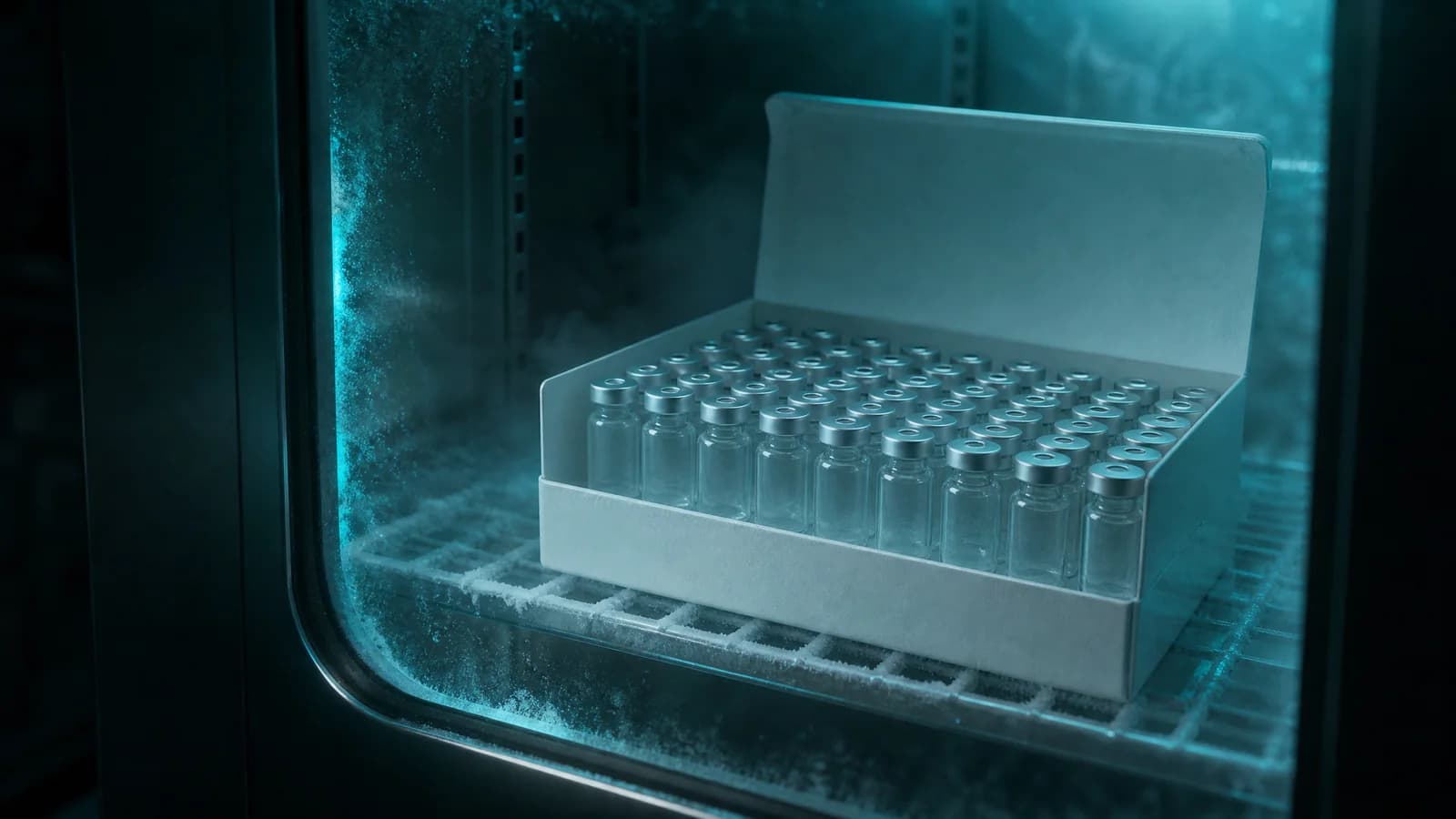
For long-term storage, the usual condition for a lyophilised peptide is −20 °C in its sealed vial, protected from light and moisture. Some laboratories keep material at −80 °C for longer periods. Over a short period some peptides are stable in a fridge at 2–8 °C, but check the label or COA rather than assuming.
A few habits help:
- Keep vials in a closed box, ideally with a desiccant sachet, so humid air doesn't reach the seal each time the freezer is opened.
- Avoid frost-free freezers for long-term storage. They warm slightly during each defrost cycle, so the contents go through small temperature swings.
- Store vials towards the back of the freezer rather than in the door, where the temperature changes most.
- Keep vials in their box, in the dark. If you move material into new containers, use amber glass or wrap them in foil.
Opening a vial
Let the vial reach room temperature before you open it, ideally in a desiccator. If you open a cold vial, moisture from the air condenses on the powder.
Work quickly once it is open. Weigh out what you need with a clean, dry spatula, wearing gloves, and reseal the vial straight away. For peptides that oxidise easily, you can flush the headspace with dry nitrogen or argon before resealing.
Peptides in solution
A peptide in solution is far less stable than the dry powder, so prepare solutions as close as you can to the experiment that needs them.
- Choose the solvent and buffer your method calls for. Many peptides are more stable in slightly acidic solutions, around pH 5 to 6, than in alkaline ones.
- Split the solution into single-use aliquots, so each portion is thawed only once, and store them frozen at −20 °C or below.
- Avoid repeated freeze-thaw cycles. They encourage aggregation and give moisture and oxygen more chances to do damage.
- Label each aliquot with the compound, batch code, concentration, solvent and date prepared.
- For very dilute solutions, use low-binding tubes. Peptides can stick to the walls of standard plastic and glass.
Records and monitoring
A simple log saves time later. For each vial, record the compound, batch code, date received, date opened, any aliquots made and where they are stored.
Monitor freezer temperatures with a min/max thermometer or a data logger, and check that alarms work. If a freezer fails, the log tells you which material was affected.
Recording batch codes in your lab notebook also means that if an experiment behaves unexpectedly, you can trace it back to the exact material used.
Disposal
Dispose of unused peptide, solutions and contaminated consumables as laboratory chemical waste, following your organisation's procedures and local rules.
At THE GROUP
Every product page lists the storage conditions for that product, and the batch COA is linked from the same page. If a vial looks wrong when it arrives, or its seal is damaged, contact us with the batch code before you open it.
THE GROUP research products are supplied for laboratory research use only. Not for human or veterinary use.